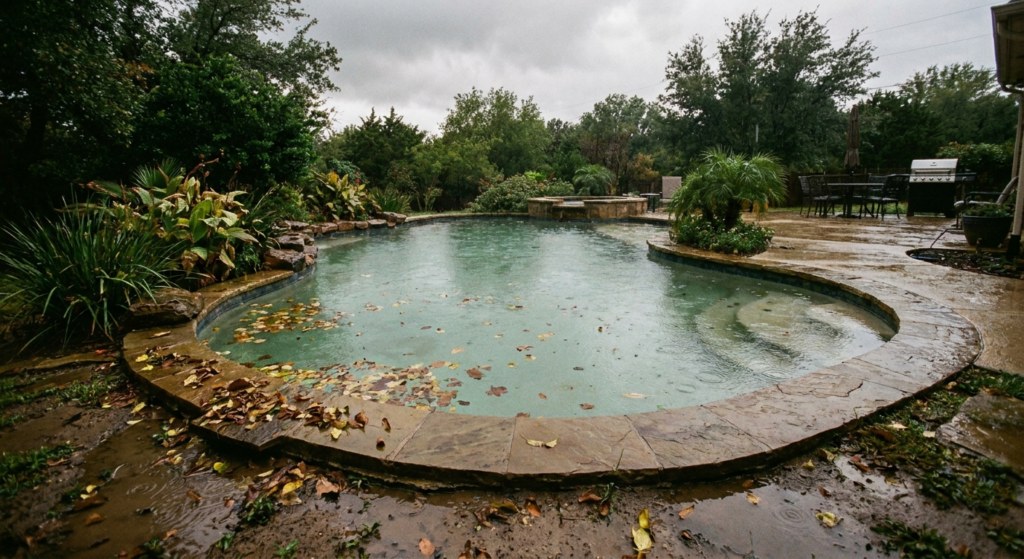

Pool water chemistry can shift quickly when the weather changes.
Rainstorms, intense heat, and strong sunlight all affect the chemical balance in your pool.
Understanding these effects helps you respond before small problems turn into costly repairs.
This guide explains how different weather conditions impact your pool and what steps to take to keep the water clear, safe, and comfortable.
How Rain Disrupts Your Pool Chemistry
Rainwater is naturally acidic, typically around 5.6 pH, while your pool should be between 7.2 and 7.6.
When rain enters the pool, it lowers the pH and dilutes the chlorine, making the water less protected.
Rain also washes in debris from roofs, trees, and lawns.
Leaves, pollen, and organic matter consume chlorine quickly and feed algae growth.
After a heavy storm, you may notice cloudy water, a drop in free chlorine, and unstable total alkalinity.
The combination of diluted chemicals and added contaminants can lead to an algae bloom within 24 to 48 hours if not corrected.
Acting quickly after rain is essential to prevent major water quality issues.
It is also wise to test total dissolved solids (TDS) after heavy rainfall, as diluted water may require rebalancing with calcium or salt.
Effects of Hot Sun and High Temperatures
Sunlight destroys chlorine molecules through UV radiation.
On a hot, sunny day, your pool can lose up to 90 percent of its free chlorine within a few hours.
Cyanuric acid, or stabilizer, acts as a sunscreen for chlorine.
When stabilizer levels are too low, chlorine burns off rapidly and leaves the pool unprotected.
High temperatures also accelerate algae growth.
Warm water, combined with low chlorine, creates ideal conditions for algae to multiply overnight.
Evaporation increases in hot weather, concentrating dissolved solids and throwing off pH, alkalinity, and calcium hardness.
This makes the water harder to balance and can lead to scaling or corrosion.
Using a liquid chlorine stabilizer can help maintain chlorine levels during peak sunlight hours.
Regular brushing of the pool walls also prevents algae buildup in warm conditions.
Steps to Restore Balance After Weather Events
Test the Water First
Always test free chlorine and pH first. Use a reliable liquid test kit for accurate results. Test strips are fine for quick checks, but when weather has disturbed the water, a liquid kit gives you the confidence to make precise adjustments.
Adjust pH and Alkalinity
If pH has dropped below 7.2 after rain, raise it using a pH increaser such as sodium carbonate.
If total alkalinity is also low, use baking soda to build buffering capacity first.
High pH from heat or evaporation calls for an acid product, added gradually. Always retest after circulation before adding more chemicals.
Restore Chlorine Levels
Add chlorine after pH is corrected. For an outdoor pool, apply chlorine in the evening to avoid UV breakdown. If chlorine keeps dropping, test cyanuric acid and bring it into the 30–50 ppm range. Stabiliser protects chlorine so it lasts longer between treatments.
Increase Circulation and Clean Debris
Run the pump for 12 to 16 hours per day after a storm or during a heat wave.
This helps distribute chemicals evenly and prevents dead zones where algae can start. Remove visible debris by hand or with a net.
For thorough cleaning, use a robotic cleaner that can handle leaves and organic matter.
Proper filtration and circulation are essential for maintaining stable chemistry.
Preventing Future Weather-Related Problems
A consistent testing schedule helps you catch changes early.
Test free chlorine and pH two to three times per week during swim season. Test alkalinity weekly and cyanuric acid monthly. After heavy rain, test within 24 hours. During heat waves, check chlorine daily.
Keep cyanuric acid in range to protect chlorine from the sun.
Maintain alkalinity between 80 and 120 ppm to buffer pH swings.
During cooler months, monitor pH and alkalinity weekly as cold water can slow chemical reactions and mask imbalances.
If you need a deeper understanding of how different chemicals interact and how to correct common imbalances, consult iGarden’s pool chemistry resource.
This guide covers ideal levels, step-by-step adjustments, and troubleshooting for real-world situations.
Common Mistakes to Avoid
Adding chemicals before testing is one of the most frequent errors. Always test first, then adjust one parameter at a time. Adding shock and acid simultaneously can create dangerous fumes. Never mix chemicals.
Another mistake is testing too soon after adding a chemical. Allow the water to circulate for several hours before retesting. Overcorrection often happens when results are taken before the water is fully mixed. After heavy rain, remember that the water volume has increased, so chemical additions need to be adjusted accordingly.
Finally, do not ignore the role of circulation. A pool with perfect chemistry can develop algae if the water does not move through all areas. Run the pump during daylight hours and ensure return jets are aimed to create good surface movement. A well-circulated pool responds faster to chemical adjustments and stays clearer between cleanings.