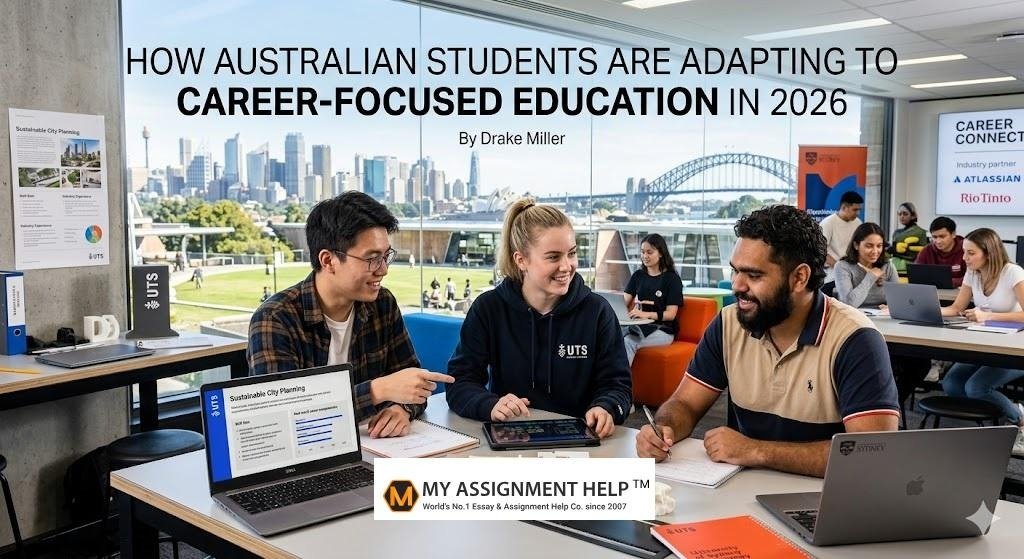

The Australian educational landscape has undergone a seismic shift. Gone are the days when a high school diploma or a general university degree was the sole ticket to professional success. In 2026, the focus has pivoted sharply toward career-focused education (CFE). From the bustling secondary schools of Sydney to the innovative TAFE hubs in regional Queensland and the tech-heavy corridors of Adelaide, students are no longer just “studying”; they are “specialising.”
As the job market becomes increasingly defined by automation, green energy, and the care economy, Australian students—from high schoolers to postgraduates—are adapting in remarkable ways. This blog explores how the class of 2026 is navigating this new frontier and why the integration of academic learning with practical industry skills is the new gold standard for the modern Commonwealth.
1. The Death of the ‘Generalist’ and the Rise of Micro-Credentials
In 2026, the traditional three-year bachelor’s degree is no longer the undisputed king. While foundational degrees remain important for deep theoretical knowledge, students are increasingly supplementing their education with micro-credentials to prove immediate competency to employers.
High school students are now graduating with more than just an ATAR (Australian Tertiary Admission Rank). Many are leaving Year 12 with industry-recognised certificates in coding, digital marketing, or sustainable project management. This “stackable” approach to education allows students to enter the workforce earlier and with more specific, marketable skills. This shift is a direct response to the “skills gap” identified in the early 2020s, where graduates possessed degrees but lacked the “day-one” technical abilities required by high-growth startups.
To bridge this gap, many students now seek case study help to master the practical application of their theoretical knowledge through real-world scenarios.
For those pursuing higher education, the trend is similar. Universities have partnered with industry giants—ranging from Atlassian to Rio Tinto—to offer short, intensive courses that respond to real-time market demands. Whether it’s a nursing student taking a weekend intensive on robotic-assisted surgery or a business major earning a certificate in AI ethics, the focus is on immediate employability. The Australian Qualifications Framework (AQF) has been updated to reflect these changes, ensuring that a micro-credential earned online carries the same weight as a traditional unit of study.
2. VET and Apprenticeships: No Longer the ‘Plan B’
For decades, Vocational Education and Training (VET) was often viewed as a secondary option for students who didn’t “make the cut” for university. In 2026, that stigma has vanished. The Australian government’s heavy investment in the National Skills Agreement has transformed TAFEs into world-class innovation hubs that rival elite universities in terms of facilities and industry prestige.
High school students are increasingly opting for school-based apprenticeships, allowing them to earn a wage while completing their senior secondary certificate. This model has proven particularly successful in regional areas, where local industries are hungry for young talent.
Fields like renewable energy technology, cybersecurity, and advanced manufacturing are seeing a surge in enrolments. Students recognise that these “new-collar” jobs offer high salaries, job security, and a clear career trajectory without the burden of massive HECS-HELP debts associated with some long-form degrees. In the current 2026 economy, a certified cybersecurity technician can often command a starting salary higher than a junior corporate lawyer, a fact not lost on the pragmatic Gen Z and Gen Alpha students entering the workforce.
3. The Integration of AI and Virtual Reality in the Classroom
Adaptation in 2026 isn’t just about what students are learning, but how they are learning. Career-focused education has embraced immersive technology to bridge the gap between the classroom and the workplace.
In high schools across Victoria and New South Wales, VR (Virtual Reality) is used to simulate high-stakes work environments. A student interested in civil engineering can virtually walk through a construction site to identify safety hazards, while a budding healthcare worker can practice patient interactions in a simulated ward. This “risk-free” experiential learning accelerates the development of spatial and technical awareness.
Furthermore, AI-driven career platforms are now standard in Australian secondary schools. These tools analyze a student’s strengths, interests, and real-time economic data—such as the National Skills Priority List—to suggest specific educational pathways. This data-driven approach ensures that students aren’t just following a passion; they are following a path that leads to a viable, high-demand career.
4. Regional Specialisation: From Mining Tech to Space Defence
To understand the 2026 educational landscape, one must look at the regional specialisations driving the Australian economy. Education is no longer “one-size-fits-all” across the states.
- Western Australia (WA): Students in Perth and the Pilbara are focusing heavily on mining technology and autonomous systems. High schools have integrated drone piloting and remote operations into their VET streams to prepare students for the massive automation shift in the resource sector.
- South Australia (SA): Adelaide has become a hub for the space and defence sectors. Consequently, secondary and tertiary curricula in SA have pivoted toward aerospace engineering and sophisticated electronics, with students often engaging in internships with global defence contractors before they finish their degrees.
- Queensland: The focus remains on the “Green Economy” and hospitality tech, as the state prepares for a sustainable tourism boom. Agricultural students in regional QLD are mastering ag-tech and regenerative farming practices to combat climate change challenges.
5. Soft Skills in a Hard-Tech World
While technical proficiency is vital, Australian students in 2026 are placing an unprecedented value on “Human Skills.” As generative AI handles more routine tasks and data analysis, the premium on emotional intelligence, critical thinking, and cross-cultural communication has skyrocketed.
Secondary and tertiary curricula now explicitly bake these “soft skills” into career-focused streams. Students participate in “Industry Challenges” where they must work in multidisciplinary teams—a mix of coders, designers, and business students—to solve real-world problems for local businesses. This fosters a mindset of adaptability—a trait essential for a generation that is expected to change careers (not just jobs) at least five times in their lives.
6. Managing the Pressure: The Role of Academic Support
The shift toward a career-focused model is exciting, but it brings intense pressure. Students are expected to be industry-ready earlier than ever before. Balancing VET certificates, part-time apprenticeships, and traditional curriculum requirements can be overwhelming for even the most dedicated students.
The transition from theoretical learning to professional-grade documentation is a significant hurdle. Whether it is mastering the nuances of industry-specific case studies or navigating complex technical reports, students are increasingly turning to expert resources. For those struggling to keep up with the rigorous demands of 2026’s academic standards, professional services can provide the necessary edge. If you find yourself bogged down by the transition, Myassignmenthelp provides the necessary support to help bridge the gap between theoretical assignments and practical applications, allowing students to focus on their hands-on training without falling behind in their academic requirements.
7. The “Green Skills” Revolution
Australia’s commitment to becoming a renewable energy superpower has filtered down into every level of education. In 2026, “Green Skills” are no longer just for environmental scientists; they are for everyone.
- Architecture students are focusing exclusively on carbon-neutral urban design and circular economy principles.
- Automotive apprentices are specialising in Electric Vehicle (EV) maintenance and hydrogen fuel cell technology, as the phase-out of internal combustion engines accelerates.
- Accounting students are being trained in ESG (Environmental, Social, and Governance) reporting, as companies face stricter carbon disclosure laws.
Students are adapting by choosing electives and pathways that align with the “Net Zero” economy, recognizing that the most lucrative and stable careers of the future are those that contribute to a sustainable planet.
Frequently Asked Questions
Q.1 What is the benefit of choosing VET over a traditional University degree in 2026?
The primary benefit is speed to market and reduced debt. VET qualifications are designed in collaboration with industry, ensuring students learn exactly what employers need right now. In 2026, VET graduates in high-demand fields like cybersecurity or renewable energy often enter the workforce with higher starting salaries and lower HECS-HELP debt than those completing four-year generalist degrees.
Q.2 How can high school students improve their employability before graduating?
Students should look beyond their ATAR. Engaging in school-based apprenticeships, completing micro-credentials in digital literacy or project management, and building a professional presence on platforms like LinkedIn are crucial steps. Participation in “Industry Immersion Days” also helps build the networking skills that are vital in the 2026 job market.
Q.3 Are micro-credentials recognized by major Australian employers?
Yes. Following the 2025 update to the Australian Qualifications Framework, micro-credentials are now formally recognized and “stackable.” Major employers in the mining, tech, and healthcare sectors actively seek candidates who show a commitment to continuous learning through these short, intensive courses.
Q.4 What should I do if I am struggling with the technical requirements of career-focused courses?
Career-focused education often requires high-level technical writing and industry-standard documentation. If you find these practical applications challenging, seeking professional academic support is a smart move.
Conclusion: A Generation Ready for Work
The Australian student of 2026 is a different breed. They are pragmatic, tech-savvy, and deeply attuned to the needs of the global economy. By embracing career-focused education, they are closing the “skills gap” that plagued previous generations.
While the transition hasn’t been without its challenges—including increased cognitive load and the pressure to specialize early—the result is a more resilient and capable workforce. Whether through micro-credentials, advanced apprenticeships, or the mastery of AI-driven tools, Australian students are proving that they are ready to lead in the mid-21st century.
As education continues to evolve, staying informed and seeking the right support remains the best strategy for success. The future of Australian education isn’t just about getting a degree—it’s about building a career from day one. By leveraging the right technology, regional opportunities, and academic support, the Class of 2026 is set to redefine what it means to be a professional in the modern world.
About the Author – Drake Miller
I am a dedicated blog author associated with Myassignmenthelp.services, focused on creating clear, engaging, and informative content for students worldwide. My writing covers academic guidance, study techniques and practical learning tips across various subjects. I aim to simplify complex ideas and help learners achieve academic success with well-researched, original and student-friendly content.