
The landscape of higher education has undergone a seismic shift. As we navigate the 2026 academic year, the “traditional” exam has been largely replaced by sophisticated digital assessments that demand more than just rote memorization. Today’s students are evaluated on their ability to synthesize information, manage time under algorithmic proctoring, and utilize technical resources efficiently.
To secure an A+ in this competitive environment, relying on a standard word processor and a few browser tabs is no longer sufficient. Success requires a curated “Academic Tech Stack“—a suite of tools designed to streamline research, fortify integrity, and optimize cognitive performance.
The Evolution of the 2026 Exam Environment
Modern online exams are increasingly leaning toward “Open Application” formats. According to recent data from the National Center for Education Statistics (NCES), over 75% of post-secondary institutions now utilize AI-integrated proctoring services. These systems don’t just watch for movement; they analyze pacing and tab-switching behavior. Consequently, the tools you use must be integrated into your workflow long before the exam timer starts.
In quantitative subjects, the pressure is even higher, as students are often required to build complex models in real-time. For those struggling with data visualization or complex formulas, the choice to do my excel assignment with the help of a professional can be a game-changer, allowing them to learn best practices and master the software before the high-stakes environment of a final exam. Mastering these technical skills early ensures that when the clock starts, your focus remains entirely on the subject matter, not the software.
1. Advanced Research & Information Synthesis
In 2026, the sheer volume of data available can be a distraction. The goal is “Smart Retrieval.“
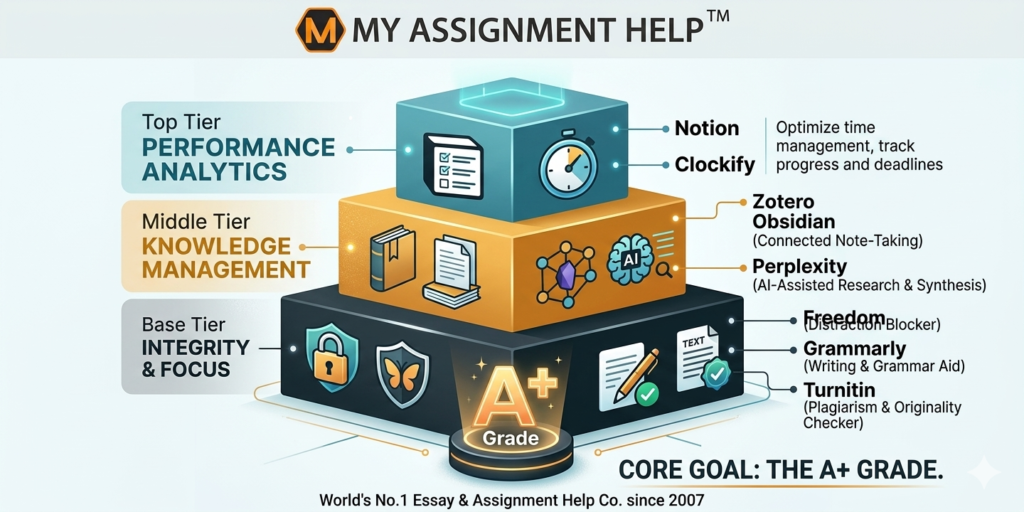
- Zotero 7.0: This remains the gold standard for reference management. The latest updates allow for seamless integration with AI research assistants that can summarize 50-page white papers into five key bullet points.
- Perplexity AI (Pro Version): Unlike standard LLMs, Perplexity provides real-time citations. For take-home or open-book exams, it serves as a high-speed library card, pointing you toward peer-reviewed journals and verified datasets rather than generic web content.
- WolframAlpha: For STEM students, WolframAlpha is indispensable. It provides step-by-step solutions for complex calculus, physics, and engineering problems, ensuring you understand the logic behind the result.
2. Cognitive Optimization and Focus Tools
Distraction is the greatest enemy of the online examinee. Research from the Journal of Educational Psychology suggests that “task-switching” can reduce productivity by up to 40%.
- Freedom.to: This cross-platform blocker allows you to schedule “Exam Modes” where social media, news sites, and even specific desktop apps are completely inaccessible across all your devices.
- Endel: Using neuro-acoustic patterns, Endel creates personalized soundscapes that adapt to your heart rate and the time of day, helping you maintain a “Flow State” during high-stakes testing.
3. Writing and Integrity Verification
With the rise of E-E-A-T (Experience, Expertise, Authoritativeness, and Trustworthiness) standards in academic grading, your writing must be sharp, original, and well-supported. Working with a dedicated assignment helper can assist in refining your arguments and ensuring your work meets these high academic benchmarks.
- Grammarly Author: The 2026 iteration goes beyond typos. It evaluates the “tonal authority” of your essay, ensuring you sound like a subject matter expert.
- Turnitin Draft Coach: This tool is now available for individual student use in many US universities. It allows you to check your similarity index in real-time, preventing accidental plagiarism before you hit “submit.”
Data-Driven Insights: Why Tooling Matters
A 2025 study by the International Journal of Educational Technology in Higher Education found that students who utilized specialized project management tools (like Notion or Trello) for exam prep scored, on average, 12% higher than those using traditional paper notes. The difference lies in “Retrievability“—the speed at which a student can locate a specific fact during a timed window.
Strategic Time Management
The most successful students in 2026 use the “3-2-1 Prep Method“:
- 3 Weeks Out: Index all digital notes in a searchable database (like Obsidian).
- 2 Weeks Out: Run simulated exams using specialized proctoring-emulation software.
- 1 Week Out: Finalize “Cheat Sheets” (if allowed) using Canva for high-density visual organization.
Key Takeaways
- Integrate Early: Don’t download a tool the night before an exam. Use it for at least three weeks to build muscle memory.
- Verify Sources: Always cross-reference AI-generated summaries with primary sources using Zotero or Mendeley.
- Secure Your Environment: Use hardware-level blockers to ensure your proctoring software doesn’t flag suspicious background activity.
- Prioritize E-E-A-T: Ensure your written responses demonstrate expertise and cite authoritative data.
Frequently Asked Questions (FAQ)
Q1: Can proctoring software detect these tools?
Most “Lockdown” browsers will prevent you from opening other apps. However, these tools are primarily for the preparation phase or for “Open App” exams. Always check your syllabus for specific software restrictions.
Q2: Are AI research tools considered cheating?
In 2026, most US universities distinguish between “AI-assisted research” and “AI-generated submission.” Using AI to find a source is generally accepted; using it to write your exam is not.
Q3: What is the best tool for math-heavy exams?
WolframAlpha and Symbolab remain the leaders for computational accuracy and step-by-step logical breakdowns.
Q4: How can I ensure my essay meets E-E-A-T standards?
Focus on using high-quality references (the “.edu” or “.gov” domains) and clearly explain the methodology behind any data you cite.
About the Author
Dr. Sarah Jenkins is a Senior Academic Consultant at MyAssignmentHelp. With over a decade of experience in digital curriculum design and a Ph.D. in Educational Technology from Stanford University, Dr. Jenkins specializes in helping students leverage modern software to overcome learning barriers. She has published numerous papers on the intersection of AI and academic integrity in the US higher education system.
References
- National Center for Education Statistics (2025). “Digital Transformation in Higher Education Trends.”
- Journal of Educational Psychology (2024). “The Impact of Task-Switching on Remote Testing Performance.”
- International Journal of Educational Technology (2025). “Knowledge Management Systems and Student GPA Outcomes.”
- HESA (Higher Education Statistics Agency). “Global Trends in Online Assessment 2025-2026.